The Land
Why this range.
Why this district.
Why this crop.
Three decisions sit underneath everything else we do. None of them was made because the land was cheap, and all three are open to being argued with.
01 — The Range
India’s largest underused resource.
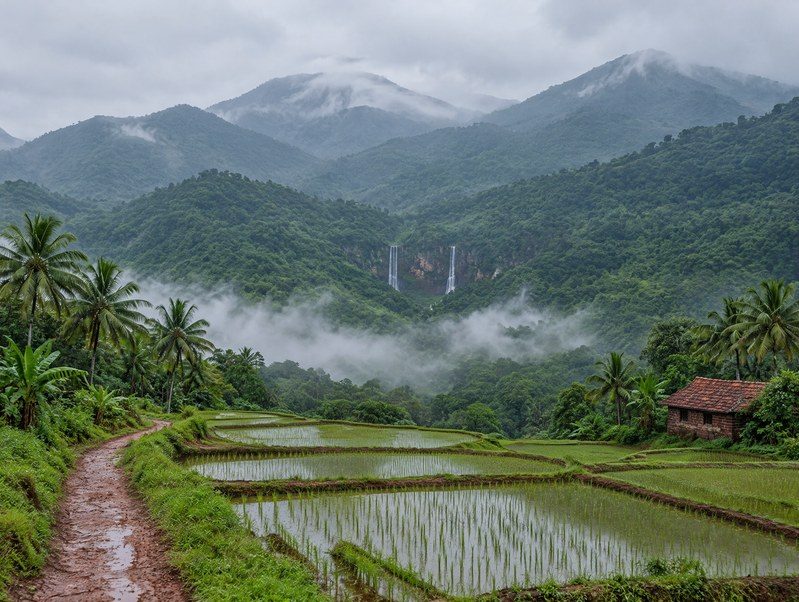
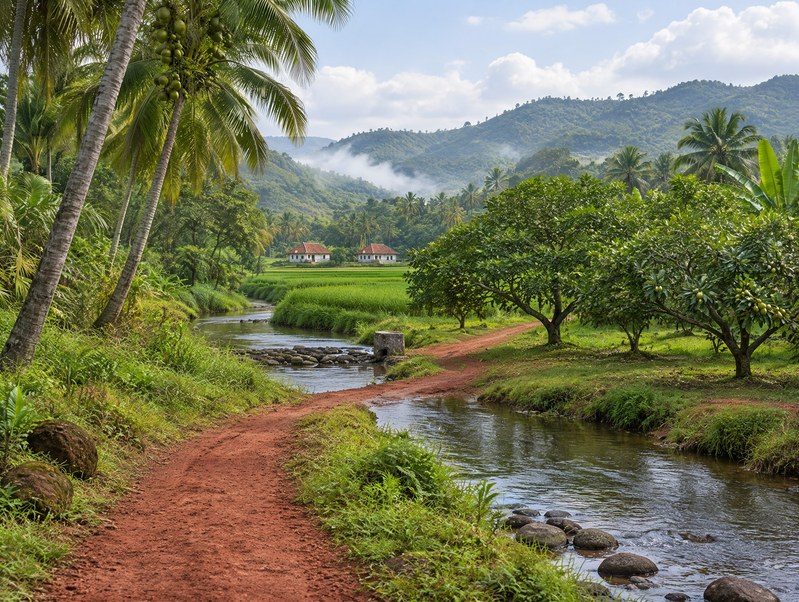
The Western Ghats run roughly sixteen hundred kilometres down the western edge of the country. They catch the monsoon before anywhere else does, which is why the soil is what it is — and why a great deal of this land has been farmed, in some form, for a very long time.
A great deal of it is also sitting idle. Holdings fragmented by inheritance until no single parcel was worth working. Owners who moved to cities two generations ago. Land that is fertile, rain-fed and entirely capable of producing — and produces nothing, because nobody is farming it at a scale where farming pays.
That gap is the whole opportunity, and it is not a complicated one. Assemble enough contiguous acres for mechanisation and year-round management to make sense. Put in a crop suited to the rainfall and the slope. Farm it properly, for decades. The land does the rest, as it always has.
- Entry-level valuations. Farmland here still trades at a fraction of what comparable rain-fed land costs in better-known agricultural belts.
- Scale is available. Fifty contiguous acres can still be assembled here. In most of India that sentence is no longer true at any price.
- It creates work. Every acre brought back into cultivation is steady, local, year-round employment in the villages around it — which is also what makes a farm defensible in the long run.
02 — The District
Where the Konkan meets Goa.
Sawantwadi sits in Sindhudurg district, at the southern end of Maharashtra on the Goa border. It is a serious piece of countryside with an unserious amount of attention on it — which is exactly the moment you want to be buying.
We did not pick it because it was the cheapest land we could find. We picked it because it is the only place on this coast where all four of the things below are true at the same time.
Four airports, a highway, a railway
Goa Mopa and Sindhudurg Chipi are closest, with Dabolim and Kolhapur beyond. NH-66 and the Konkan Railway run through the district — an afternoon from Mumbai, Pune or Bengaluru.
Heavy monsoon, laterite soil
One of the heaviest monsoons in the country, over well-drained laterite soils suited to exactly the crops this coast has always grown: cashew, mango, areca, coconut — and bamboo.
A heritage, not an experiment
The Konkan has grown, cut and built with bamboo for centuries. The species, the harvesting knowledge and the labour are already here. We are farming the crop that belongs.
Before the growth arrives
Mopa airport, highway widening and Goa’s steady spill northwards are all pointed at this district. Valuations have not caught up yet. Windows close.
03 — The Crop
The crop that keeps giving.
Bamboo is a grass, not a tree. Nearly everything that makes it a good crop follows from that one botanical fact — including the law that governs cutting it.
Harvest a bamboo clump and you have not killed it. The root system is intact, and it sends up new culms the following season. A well-managed clump is still producing forty years after it was planted, from a single act of planting. For an owner, that is the difference between a crop you re-establish every cycle and an asset that compounds quietly in the ground.

The agronomy
- Plant once, harvest for decades. The clump regenerates from its own rhizome after every cut, with a productive life of forty years and more.
- Commercial harvest in roughly four to five years. Faster than almost any woody crop, and slow enough that anyone promising you income in year two is not describing bamboo. Why it takes that long.
- Selective harvesting. Culms are cut by age, a proportion of the clump at a time. The plantation is never clear-felled, so the asset is never reset.
- Suited to this terrain. It holds soil on slopes where row crops cause erosion, tolerates the laterite profile, and asks far less of a dry season than most alternatives.
- The species belong here. Dendrocalamus stocksii — Manga or Konkan bamboo, native to the central Western Ghats and long grown across Maharashtra, Goa, Karnataka and Kerala — is among the species prioritised for commercial cultivation in peninsular India. Final species mix is set per site, by soil and slope.
The market and the law
- Demand runs ahead of supply. India has the world’s largest area under bamboo, yet it imports large quantities of raw and semi-processed bamboo every year — a gap between what the country grows and what its industries use (Centre for Civil Society, 2022).
- No felling or transit permit. The Indian Forest (Amendment) Act, 2017 removed bamboo grown on non-forest land from the Act’s definition of “tree”, lifting the felling and transit permit requirement that had discouraged private cultivation for ninety years. Bamboo in forest areas remains regulated.
- Policy support. The restructured National Bamboo Mission backs cultivation and processing across the sector, with the Konkan among the regions it covers.
- Many markets, not one. Construction and scaffolding, furniture and panels, agarbatti sticks, paper and pulp, charcoal and biomass, and an engineered-bamboo segment that is growing. A crop with one buyer is a risk; bamboo has a sector.
- Our offtake is in-house. The entire production from our farms is consumed by our own processing unit — which removes the question of who buys the harvest, without pretending to fix its price.
Before You Decide
Come and stand on it.
Nobody should buy fifty acres they have not walked. We will not let you — a site visit is part of our process, not a reward for signing something.
Walk the parcels
The actual land under consideration, with its boundaries, its soil, its water and its access. In the season you happen to come, not the season the photographs were taken.
Meet the operating partner
The people who would farm it. Ask them what goes wrong, how often, and what they do about it. Their answers will tell you more than any document we could send.
See an established planting
A plantation already in the ground, a few years in. Bamboo at year three looks very different from bamboo in a rendering, and you should know which one you are buying.